
Wayfinding: A Guide to Commercial Flooring Design
Published February 10, 2026 | By AHF Contract®
Every day, people navigate complex environments. Hospitals. Airports. Campuses. Office buildings. Retail centers.
And despite modern architecture and extensive signage, many still struggle to find their way.
At its core, wayfinding is the process of helping people orient themselves, choose a route, stay on that route, and recognize when they have arrived. It relies on environmental cues such as layout, landmarks, color, materials, and visual patterns to reduce confusion and support confident movement.
Flooring plays a far greater role in that process than many realize.
Key Takeaways
- Wayfinding helps people orient, navigate, and move confidently through complex spaces.
- Research shows that navigation challenges are common and directly affect stress, perceived safety, and engagement.
- Wayfinding is a system that extends beyond signage to include layout, materials, and visual cues.
- Commercial flooring plays a unique role because it is continuous, intuitive, and directly tied to movement.
- Flooring techniques such as color coding, pattern direction, zoning, and material transitions support navigation without visual clutter.
- The most effective wayfinding strategies integrate flooring with signage, lighting, and accessibility considerations.
What Research Shows About Wayfinding and Human Behavior
Studies consistently show that wayfinding challenges are not isolated issues. They are widespread and measurable.
Recent research surveying venue visitors across North America found that more than half of people experience navigation problems in large or unfamiliar spaces. Nearly 80% of visitors use wayfinding tools to navigate (Source: MappedIn).
Common wayfinding issues included:
- 24% couldn’t locate restrooms or exits quickly
- 24% wasted time searching for stores, gates, or amenities
- 20% felt anxious about not knowing where to go
- 16% felt lost entirely trying to find a specific location
That same research also showed that wayfinding directly ties to discovery and engagement. For example, 50% of visitors are discovery-oriented. They don’t have a specific purchase in mind, but come to browse, socialize, and explore venues.
In short, wayfinding is not just about movement. It shapes experience, perception, and behavior.
Why Wayfinding Matters to the Human Experience
Wayfinding reduces cognitive load.
When people must stop, search, or second-guess themselves, they expend mental energy on navigation rather than on why they are there.
- In healthcare environments, this can increase anxiety.
- In workplaces, it disrupts productivity.
- In public and retail spaces, it shortens visits and limits exploration.
Effective wayfinding allows people to move intuitively. They feel more comfortable, more confident, and more in control.
Spaces that support navigation are perceived as safer, more welcoming, and more efficient, regardless of their size or complexity.
The Science Behind How People Navigate
Wayfinding is rooted in how humans perceive and process information.
In his book, The Image of the City, urban planner Kevin Lynch identified five core elements people use to understand and navigate the built environment:
- Paths: routes people travel
- Edges: boundaries or barriers
- Districts: zones with shared visual identity
- Nodes: intersections or decision points
- Landmarks: memorable reference points
These elements work together to form a mental map of a space.
That mental map stems from spatial cognition, the process by which the brain stores and recalls information about location, distance, and direction. Visual cues play a dominant role, which is why consistent environmental signals are so effective.
The Functional Types of Wayfinding and How People Use Them
Wayfinding systems are often categorized by the function of their guidance, most commonly into four core types of signs:
- Directional: Arrows, paths, and cues that guide people from one point to another
- Identification: Room names, department labels, and building numbers that confirm arrival
- Informational: Maps, directories, hours, and amenity listings that help people orient themselves
- Regulatory: Rules, safety notices, exits, and restrictions that support compliance and security
Some environments also include confirmational cues and digital tools that reassure people they are on the correct route or provide real-time updates.
Stages of Wayfinding in the Design Process
Together, these elements support the three essential stages of wayfinding:
- Orientation: understanding where you are
- Decision-making: choosing a route
- Destination recognition: knowing when you have arrived
Effective wayfinding systems rely on a combination of these functions, layered throughout the environment so people receive the correct information at the right moment.
Signage often carries the most explicit messaging. However, the environment itself can reinforce each of these functions.
That is where flooring becomes especially powerful.
How Flooring Systems Support Wayfinding
| Wayfinding Function | Traditional Tool | Flooring Contribution |
| Directional | Arrows, signs | Linear patterns, color paths |
| Identification | Room signs | Distinct flooring at destinations |
| Informational | Maps, directories | Zoning through color and layout |
| Regulatory | Exit signs, rules | Contrast, tactile cues, boundaries |
How Commercial Flooring Reinforces Every Type of Wayfinding
Flooring does not replace signs. It strengthens them.
Because it’s continuous and directly tied to movement, flooring can support each functional type of wayfinding in subtle, intuitive ways.
Directional Wayfinding
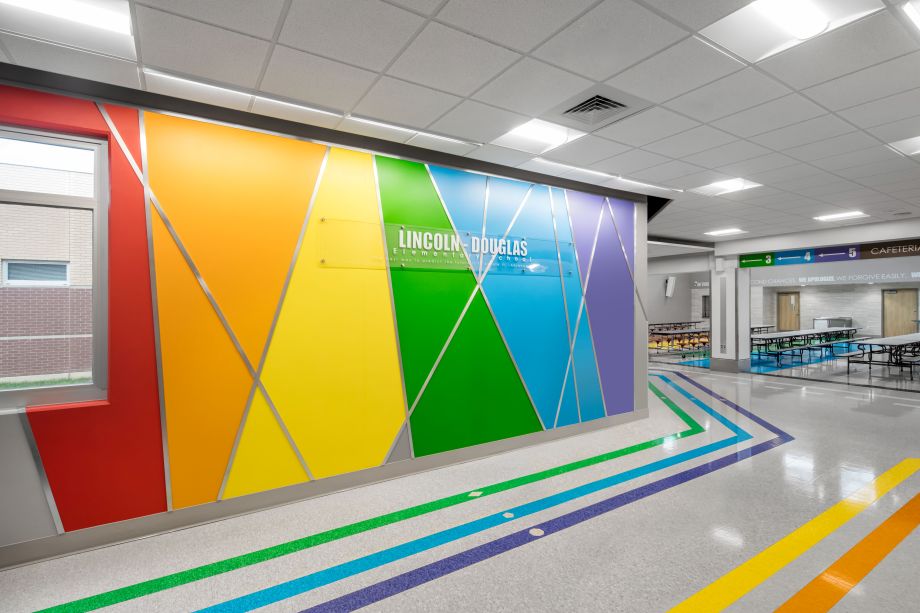
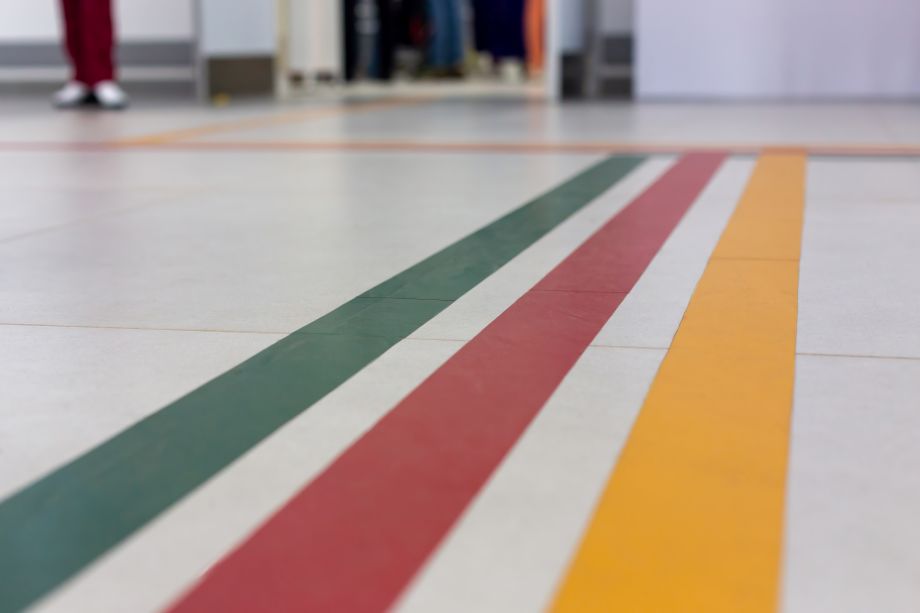
Flooring patterns, color bands, and linear layouts can establish clear paths through a space. These visual cues guide movement much like arrows do, but without requiring people to stop and read.
Identification and Confirmation
Distinct flooring treatments at entrances, reception areas, elevators, or department areas help users recognize they have reached the correct location. A change underfoot can serve as a confirmational cue that reinforces signage.
Informational Support
Zoning through flooring helps people understand the organization of a space. When public, semi-private, and restricted areas are visually distinct, people gain context without relying solely on maps or directories.
Regulatory and Safety Reinforcement
Flooring can guide people toward exits, signal restricted zones, support distancing, and improve accessibility through contrast and tactile elements. These cues are especially valuable in high-stress or emergencies, when rapid comprehension is most critical.
“Flooring allows the environment to do some of the communicating. It reinforces direction, purpose, and transition in a way that feels natural.” – Oxana Dallas, Principal Designer, Commercial at AHF.
How to Use Flooring as a Wayfinding Tool
Flooring supports wayfinding most effectively when it is intentional, consistent, and integrated into the overall design system. Rather than relying solely on signage, designers can use flooring to quietly guide movement, define space, and reinforce orientation through visual and tactile cues.
Here are several proven techniques for using flooring to support wayfinding in commercial environments.
Color Coding for Orientation and Navigation
Color is one of the fastest ways people process information.
Assigning specific colors to zones, departments, or functions helps users build a mental map of a space. In hospitals, for example, color-coded corridors can guide visitors to different wings. In educational environments, designers can use colors to distinguish grade levels or shared resources.
When used consistently, color-coded flooring reduces reliance on signs and helps people recognize their location at a glance.
Lines and Visual Paths That Guide Movement
Continuous lines, bands, or directional patterns can create visual “paths” that naturally lead people through a space.
Patterns such as herringbone, linear planks, or elongated tile layouts leverage Gestalt principles to guide the eye along a continuous path. These paths are especially effective in corridors, large open areas, and transitions between major destinations.
Because these cues are embedded in the floor, they guide movement without requiring people to stop and interpret instructions.
Zoning Through Pattern and Layout
Designers can use flooring patterns to define zones within a larger space.
Changes in pattern, scale, or orientation help differentiate functional areas such as reception zones, waiting areas, collaboration spaces, or circulation paths. That allows people to understand the space’s organization without reading a directory.
Clear zoning also supports better flow by signaling where movement should continue and where it should slow down or stop.
Texture Changes with Flooring to Signal Transitions
Texture is a subtle but powerful wayfinding tool.
Transitions from smooth to textured surfaces can signal a change in function, such as moving from a public corridor into a private area. Texture can also enhance safety by improving traction in specific regions or highlighting critical transitions.
These tactile cues complement visual cues to reinforce orientation, particularly in high-traffic or high-stress environments.
Tactile Indicators for Accessibility
Flooring plays a critical role in accessible wayfinding.
Raised bars, detectable warning surfaces, and contrasting textures can guide visually impaired users along safe routes and alert them to changes such as intersections, ramps, or platform edges. When designed correctly, these elements support independence while meeting accessibility standards.
Incorporating tactile cues into flooring helps ensure wayfinding systems serve all users, not just those who rely on visual information.
Embedded Graphics and Iconography
Symbols, icons, or subtle graphics can be integrated directly into flooring to reinforce direction or identify destinations.
These may include arrows, color blocks, or simple shapes that correspond with signage or digital maps. Embedded graphics provide instant recognition and reduce the need for additional wall-mounted signage.
When used sparingly, they add clarity without overwhelming the environment.
Material Variations in Commercial Flooring to Define Space and Flow
Material changes are another effective means of communicating function and hierarchy within a space. Transitions between materials such as tile, carpet, rubber, or resilient flooring can help define routes, separate zones, and signal destination areas.
Even subtle shifts within the same material family can create distinction while maintaining a cohesive aesthetic.
This approach is instrumental in open-plan environments, where transitional flooring helps define distinct zones without walls and supports natural pathways and traffic flow.
For example, pairing carpeting in lounge or collaboration areas with resilient LVT in high-traffic corridors visually communicates different functions while maintaining continuity across the space.
For more on how designers use flooring transitions to address design challenges and elevate commercial spaces, see “Transitional Flooring – Solving the Design Dilemma.”
Material variation also supports durability and performance requirements across different parts of a facility. Because transitional flooring can handle both functional demands and visual continuity, it strengthens wayfinding by reinforcing spatial logic underfoot rather than relying solely on surface signage.
Flooring-Based Wayfinding in Practice
These techniques are already widely used across commercial environments.
- Healthcare facilities use color-coded corridors and textural changes to guide patients and visitors while reducing anxiety.
- Education spaces rely on color, pattern, and shapes to help younger users navigate independently.
- Commercial and workplace environments use pattern direction and zoning to support flow and flexibility as layouts evolve.
In each case, flooring serves as a consistent, intuitive guide that complements signage and digital tools.
“When flooring design occurs with wayfinding in mind, it helps people move confidently through a space without feeling directed or overwhelmed.” – Oxana Dallas, Principal Designer, Commercial at AHF.
Flooring Design and Its Wayfinding Impact
| Flooring Technique | Wayfinding Benefit |
| Color coding | Improves orientation |
| Pattern direction | Guides movement |
| Material transitions | Defines zones |
| Texture changes | Signals transitions |
| Tactile indicators | Improves accessibility |
Best Practices for Using Flooring in Wayfinding Design
Wayfinding requires clarity, consistency, and an understanding of how people perceive and navigate space.
“The most successful wayfinding strategies are the ones people don’t notice. When flooring, layout, and visual cues are aligned, navigation feels effortless rather than instructional.” – Oxana Dallas, Principal Designer, Commercial at AHF.
The most effective flooring-based wayfinding systems follow these best practices.
Prioritize Contrast for Visibility
Contrast is one of the most critical factors in wayfinding.
Clear differences in color, tone, or light reflectance value (LRV) between paths, zones, and surrounding areas help people distinguish where to walk and where spaces change function. Strong contrast improves legibility at a distance and supports users with low vision.
When contrast is subtle or inconsistent, wayfinding cues are more likely to go unnoticed.
Create Clear Paths That Guide the Eye
Flooring can guide movement by working with natural visual behavior.
Continuous lines, linear plank layouts, or directional patterns draw the eye forward and subtly encourage movement along a route. These cues are especially effective in corridors, large open spaces, and transitional areas where people may hesitate.
Directional flooring is most effective when it is uninterrupted and easy to follow.
Define Zones to Support Orientation
Distinct flooring treatments help people understand the organization of a space.
Changes in pattern, color, or scale can define waiting areas, circulation routes, destination zones, or restricted spaces. Clear zoning reduces confusion and allows users to orient themselves without relying solely on signage or maps.
The goal is instant recognition, not explanation.
Incorporate Tactile Cues for Accessibility
Flooring plays a critical role in accessible wayfinding.
Textured surfaces, raised bars, or detectable warning elements can guide visually impaired users along safe routes and alert them to changes such as intersections or transitions. These elements should install flush with the surrounding flooring and properly aligned to ensure safe, predictable movement.
Accessible wayfinding benefits everyone, not just those with disabilities.
Consider Light and Pattern Direction Together
Lighting and flooring work hand in hand.
Plank direction, pattern orientation, and surface finish can interact with natural and artificial light to either enhance or obscure wayfinding cues. Running planks parallel to primary light sources can soften shadows, while directional patterns can draw attention toward entrances, destinations, or focal points.
Testing flooring under real lighting conditions helps ensure cues remain clear throughout the day.
Choose Materials Designed for Traffic and Use
Wayfinding flooring must perform as well as it looks.
High-traffic routes require durable materials with appropriate wear layers, while quieter zones may prioritize comfort or acoustics. Selecting the right product for each area ensures wayfinding cues remain visible and intact over time.
Durability supports consistency, which is essential for navigation.
Maintain Consistency Across Connected Spaces
Consistency builds confidence.
Maintaining consistency in plank direction, color logic, and pattern language across connected areas helps users maintain orientation as they move through a facility. Transitions should occur intentionally, such as at doorways, nodes, or functional changes, rather than randomly.
Unnecessary changes can disrupt flow and create confusion.
Design with Safety in Mind
Safety should always be part of wayfinding decisions.
Flooring materials should meet appropriate slip-resistance standards for the environment and support safe movement in all conditions. Floor graphics or painted elements should use low-VOC, non-hazardous materials suitable for commercial interiors.
In emergencies, clear and safe paths matter most.
Keep the System Simple and Integrated
The most effective wayfinding systems are easy to understand.
Overly complex patterns or excessive variation can overwhelm users and undermine navigation. Flooring should work in concert with signage, lighting, and digital tools to form a cohesive system rather than competing for attention.
Regular evaluation and maintenance help ensure wayfinding cues remain effective as spaces evolve.
Designing Wayfinding with Flooring in Mind
Wayfinding is most effective when it is considered early and designed as a system, rather than applied as an afterthought.
Flooring plays a unique role in that system. It is consistent, intuitive, and capable of guiding users through complex environments without introducing visual noise.
AHF Contract®: Commercial Flooring to Support Wayfinding Designs
At AHF Contract®, we work with designers, specifiers, and facility teams to use commercial flooring as a wayfinding tool to support navigation, accessibility, safety, and experience across healthcare, education, workplace, and public environments.
When flooring, layout, and visual cues are aligned, spaces become easier to navigate and more comfortable to use.
Good wayfinding does not draw attention to itself. It simply helps people feel confident in where they are and where they are going.
To learn more about flooring-led wayfinding strategies, connect with an AHF Contract representative or call 1-866-243-2726.
Related Design Insights from AHF Contract
Explore more perspectives on how flooring influences experience, movement, and design strategy: