
Vinyl Flooring in Schools: Why More Districts Are Turning to VCT
July 30, 2026 | By AHF Contract® Flooring Experts
Education construction spending is projected to reach $140.2 billion in 2025 (Source: Mordor Intelligence). As schools continue investing in renovations and long-term facility performance, flooring plays a major role in maintenance costs, durability, acoustics, hygiene, and safety.
Schools now have more resilient flooring options than ever before. Luxury Vinyl Tile (LVT), sheet vinyl, and Vinyl Composition Tile (VCT) each offer unique advantages depending on the environment. But many educational facilities are rediscovering VCT flooring because long-term durability and lifecycle value still matter.
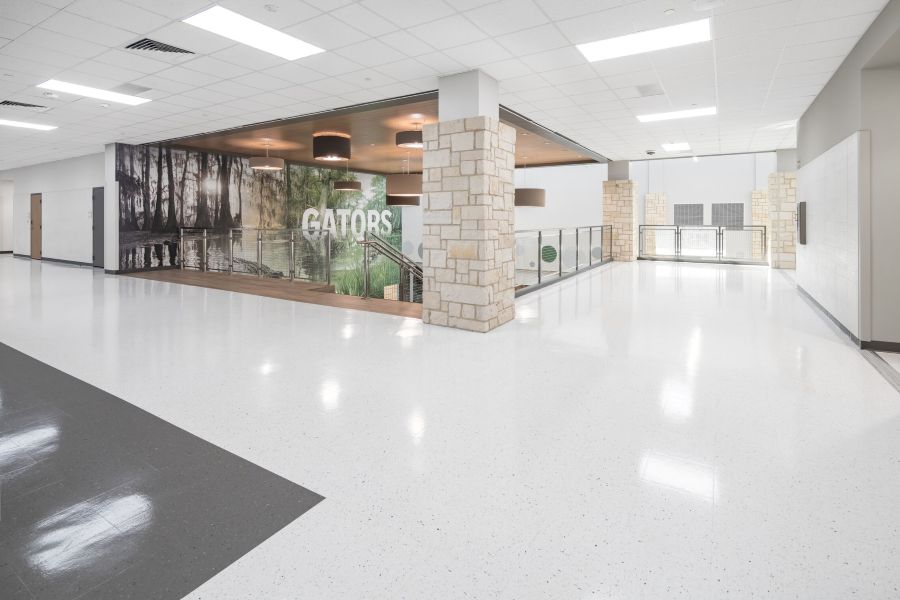
VCT Demand Continues to Increase
VCT remains one of the most proven and maintainable flooring solutions for high-traffic school environments. The global VCT market was valued at $4.2 billion in 2024 and is projected to reach $7.8 billion by 2034 (Prophecy Market Insights).
Vinyl Composition Tile has been a commercial flooring staple since its introduction in 1933.
VCT has anchored school buildings since the post-WWII boom. Modern, non-asbestos formulations have been the standard since the early 1980s. Its track record in educational environments isn’t theoretical. It spans generations.
Why Flooring Performance Matters in Schools
School flooring is evaluated against a demanding set of criteria that distinguishes it from most commercial environments. Facilities managers must account for constant foot traffic, rolling carts, and furniture movement. Then there are moisture concerns with cafeteria spills. When you also consider maintenance staffing and budgets, student safety, acoustics, and comfort, school flooring selection must cover many bases.
“School districts require a combination of style and performance. That’s one reason many facilities teams are reconsidering VCT for high-traffic educational environments.”
— Marcia Fortley, Marketing Manager – Commercial, AHF
Replacement cycles in educational facilities are long. A flooring decision made today may need to perform reliably for 20 years or more. That reality changes the calculus significantly.
School flooring is evaluated differently from many commercial environments because performance over decades matters more than short-term appearances.
Lifecycle Performance: VCT vs Surface-Layer Flooring
Lifecycle value is not about preventing wear. It’s about controlling what happens when wear occurs.
| Lifecycle Factor | VCT | Surface-Layer Flooring |
| Where wear occurs | Protective polish layer | Surface layer |
| Response to damage | Polishing or tile replacement | Plank or tile replacement |
| Long-term repairs | Localized | Often broad |
| Service model | Renew and maintain | Replace |
| Environmental impact | Lower material turnover | High turnover |
The Most Common Types of Vinyl Flooring Used in Schools
Educational facilities commonly rely on three primary resilient flooring categories: Luxury Vinyl Tile (LVT), Sheet Vinyl, and Vinyl Composition Tile (VCT). Each serves a different purpose within modern school design.
Luxury Vinyl Tile (LVT)
LVT is designed to replicate the look of wood, stone, and other natural materials. It’s become popular in administrative offices, libraries, and collaborative learning spaces where aesthetics and reduced routine maintenance are priorities.
“LVT is often selected for educational spaces where design flexibility is the top priority. Often these spaces have less foot traffic, making LVT a solid choice.”
— Marcia Fortley, Marketing Manager – Commercial, AHF
LVT considerations include:
- Strong design flexibility and modern aesthetics
- Scuff, scratch, and stain resistance
- Lower routine maintenance requirements
- The wear layer can eventually show damage and can’t be refinished
- Replacement vs. restoration increases long-term costs
Sheet Vinyl Flooring
Sheet vinyl offers a seamless or near-seamless resilient surface. It’s the preferred choice in healthcare settings and moisture-prone school areas due to its excellent moisture resistance and hygienic surface.
- Excellent moisture resistance and easy sanitation
- Ideal for restrooms, nurse stations, science labs, and kitchens
- Harder to spot-repair; damage can require larger replacement sections
- Less modular than tile-based flooring systems
Vinyl Composition Tile (VCT)
VCT is a longstanding, resilient flooring solution used throughout educational facilities. It is known for exceptional durability, repairability, and long-term performance in high-traffic environments.
Although it has often been perceived as lacking design flexibility, brands like AHF Contract® now offer more robust color palettes that remove that concern. In fact, its Iliad™ VCT won the prestigious Platinum ADEX Award for Design Excellence in 2025, and it was a Best of Year 2024 honoree with Interior Design magazine.
- Increased design flexibility for more visual impact
- Exceptional durability in hallways, classrooms, and cafeterias
- Through-color construction helps hide scratches and scuffs over time
- Individual tile replacement simplifies maintenance
- Refinishable surface extends usable life significantly
- Requires routine maintenance, including periodic polishing
Most resilient flooring products require full replacement once worn. VCT can be restored to extend its usable life for years.
LVT vs. Sheet Vinyl vs. VCT for Schools
Each flooring type offers distinct strengths depending on the needs of the educational space. The table below compares key performance attributes across all three options.
| Feature | LVT | Sheet Vinyl | VCT |
| Design Flexibility | Excellent | Moderate | Excellent |
| Moisture Resistance | Good | Excellent | Good |
| Repairability | Moderate | Limited | Excellent |
| Refinishing | No | No | Yes |
| Long-Term Durability | Good | Good | Excellent |
| Maintenance Needs | Low | Low | Moderate |
| Best For | Libraries, offices | Labs, restrooms | Hallways, classrooms |
More Schools Are Returning to VCT
Across the country, some school districts are shifting back toward Vinyl Composition Tile after evaluating long-term durability, maintenance demands, and lifecycle costs.
Some districts making that move include:
- Chicago Public Schools
- Dallas Independent School District
- Fort Worth Independent School District
- San Diego Public Schools
- Fulton County Independent School District
- Saginaw Independent School District
- Crowley Independent School District
For many facilities teams, the decision comes down to long-term maintainability. VCT continues to stand out because it can be restored, repaired, and maintained over decades of heavy daily use.
“Maintenance on VCT is universal. Compare that to LVT, which has some 80 worldwide manufacturers, many with their own maintenance protocols. It’s little wonder maintenance staff prefer VCT because it makes their lives easier.”
— Christy Reed, VP Commercial Central Region, AHF
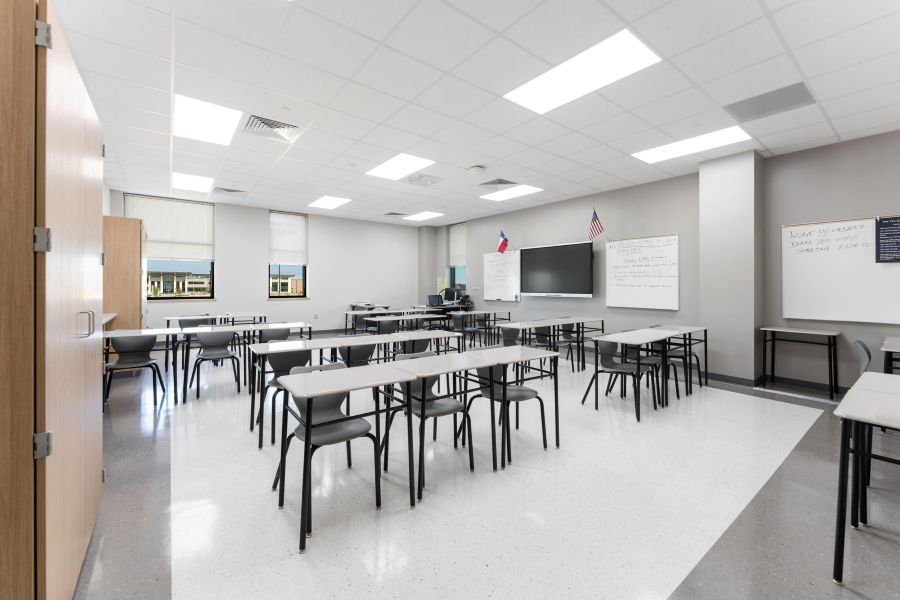
Why Many Schools Are Returning to VCT Flooring
As schools evaluate flooring performance over longer replacement cycles, many are rediscovering the advantages of VCT in demanding educational environments. Several factors are driving this renewed attention.
Long-Term Durability Matters
VCT is built for decades of foot traffic. It handles rolling loads, heavy daily wear, and the constant movement of students and staff. Its proven performance in hallways and classrooms has made it a reliable choice for facilities with high utilization and limited replacement budgets.
With proper maintenance and restoration capabilities, VCT can last for decades. That makes it one of the strongest lifecycle performances among resilient flooring options used in schools. That’s a meaningful lifecycle advantage over flooring options that can only be replaced once the wear surface is gone.
“Standard LVT products typically last five years. Once its top coating wears off, it’s easy for dirt to get into the flooring. That’s not the case with VCT. Scratch whitening repairs use a slurry with polish added, allowing maintenance staff to remove flooring blemishes. That extends the life of VCT to 25 years plus.”
— Christy Reed, VP Commercial Central Region, AHF
Through-Color Construction Helps Hide Wear
One of VCT’s most practical advantages is its through-color construction. Because the color runs through the full thickness of the tile, scratches and scuffs are far less visible than on surface-printed alternatives. That helps flooring maintain its appearance longer, which is especially valuable in high-traffic corridors.
In busy school environments, maintaining appearance is just as important as the initial design.
VCT Can Be Restored Instead of Replaced
Here’s one of the most significant differentiators between VCT and other resilient options. Through a strip-and-refinish process, VCT surfaces can be restored to a like-new condition. Refinishing extends the flooring’s life and reduces the frequency of full replacement.
For many school districts, refinishing also aligns well with summer maintenance schedules. Floors can often be restored during planned academic breaks with less disruption and downtime than full flooring replacement projects.
The refinishing process typically involves stripping old polish, thoroughly cleaning the surface, and applying four to five new coats of polish.
Typically, LVT and sheet vinyl products can’t be refinished once the wear layer is compromised. The ability to refinish VCT remains one of its most significant lifecycle advantages.
Easy Tile Replacement Simplifies Maintenance
When individual tiles are damaged, they can be replaced without disrupting the surrounding floor. This modular repairability reduces downtime, limits disruption to school operations, and supports long-term maintainability in a way that sheet vinyl and LVT cannot match.
Lifecycle Value Continues to Drive Decisions
Schools are increasingly evaluating total lifecycle cost rather than upfront price alone. When durability, restorability, and individual tile replacement are factored in, VCT often delivers one of the strongest long-term returns among resilient flooring options.
For many educational facilities, VCT continues to deliver one of the best combinations of durability, repairability, and long-term lifecycle value among resilient flooring options.
“If you polish VCT annually, that top polished layer effectively absorbs the damage. The flooring underneath suffers little impact. That’s another reason VCT offers such outstanding longevity.”
— Christy Reed, VP Commercial Central Region, AHF
Modern VCT Has Evolved as a Design Tool
VCT has a reputation as a purely utilitarian surface. For older installations, that reputation was earned. But the product has changed significantly.
Today’s VCT supports bold color systems, directional layouts, custom blends, and waterjet-cut graphics that can incorporate logos, borders, and wayfinding patterns directly into the floor.
In schools, especially, that last capability matters. Flooring frequently serves a navigational function — defining circulation paths, establishing zones, and reinforcing building identity. VCT’s color range and cuttability make it a practical tool for that kind of spatial design, not just a background surface.
As mentioned, AHF Contract®’s Iliad™ VCT collection earned a Platinum ADEX Award for Design Excellence in 2025. Interior Design also recognized it as a Best of Year product offering. That signals how far the category has come from its utilitarian origins.
Sustainability Starts with How Long a Floor Stays in Service
Sustainability in flooring is often framed around material content, including recycled inputs, low-VOC emissions, and responsible sourcing. VCT addresses all of those.
AHF Contract’s VCT, for example, uses 85% locally sourced North American limestone, an abundant and regionally available material.
But the more meaningful sustainability argument for VCT is its longevity. A floor that stays in service for decades generates significantly less material waste than one replaced every 10 to 15 years.
And remember, VCT can be refinished rather than landfilled when it shows wear. For school districts managing large footprints and long planning horizons, that reduction in material turnover is a real environmental advantage, not just a marketing point.
Where VCT Flooring Works Best in Schools
VCT performs best in areas with high foot traffic and demanding daily use. Recommended spaces include:
- Hallways and main corridors
- Classrooms
- Cafeterias and food service areas
- Common areas and gathering spaces
- Administrative offices
- Multi-purpose rooms and gymnasiums
When Other Vinyl Flooring Options Make Sense
A balanced flooring strategy recognizes that not every space has the same requirements. LVT and sheet vinyl remain strong choices in the right applications.
LVT is well-suited for:
- Design-forward environments where aesthetics are a priority
- Libraries and collaborative learning spaces
- Administrative offices
Sheet vinyl is well-suited for:
- Wet environments, including labs and restrooms
- Nurse stations requiring easy sanitation
- Kitchen and food preparation areas
Many schools ultimately use multiple flooring types throughout a facility, depending on performance needs in each space.
Choosing the Right Vinyl School Flooring for Long-Term Performance
Flooring decisions impact schools for decades. Timing matters too.
Most schools plan flooring installations and refinishing projects during summer break to minimize disruption to students and staff. That makes VCT’s low-downtime refinishing process a practical operational advantage.
Maintenance, durability, repairability, and lifecycle costs all factor into what ultimately delivers value over a building’s life. VCT continues to gain attention because it addresses many of the long-term challenges that educational facilities face every day.
While LVT and sheet vinyl continue to serve important roles in educational design, many schools are rediscovering VCT for one simple reason. It delivers proven long-term performance in demanding environments.
AHF Contract® Continues to Advance VCT Solutions
AHF Contract continues to advance VCT for schools through modern design, responsible manufacturing, and performance built for real-world use.
In addition to its elevated colors, Highlights and Iliad include an exclusive Fast Start® factory finish that makes initial maintenance quick and easy, eliminating the need for post-installation scrubbing. The flooring is ready to polish for initial use.
To explore VCT for commercial projects, speak with an AHF Contract representative at 1-866-243-2726.