
The Truth About VCT Flooring in Commercial Spaces
Published January 16, 2026 | AHF Contract® Product Expert
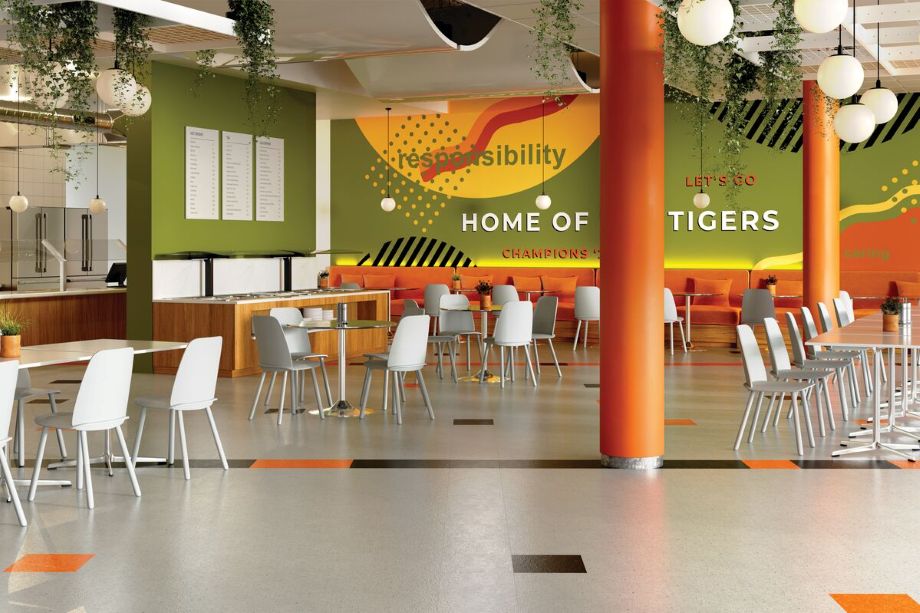
Vinyl composition tile (VCT) has quietly remained one of the most specified flooring materials in North American commercial buildings. Not because of design trends. Because of performance.
While categories such as luxury vinyl tile (LVT) dominate showroom conversations, VCT continues to anchor schools, hospitals, and retail environments where reliability comes first.
Facilities that can’t afford frequent replacement, experimental materials, or unpredictable lifecycle performance continue to specify VCT for one reason: it works.
The VCT Market Remains Robust
Here’s the first statement of truth: VCT isn’t going anywhere.
The global VCT market reached approximately $4.2 billion in 2024 and is projected to approach $7.8 billion by 2034, with North America leading commercial demand (Prophecy Market Insights).
Nostalgia isn’t fueling that growth. Institutions are driving it by evaluating flooring through total lifecycle cost, operational reliability, and real-world durability.
Yet perception lags performance. What follows are more truths about vinyl composition tile and how it performs today in commercial environments.
Key Takeaways
- VCT remains one of the most installed commercial flooring materials in North America.
- Global demand continues to rise across education, healthcare, and retail.
- Properly maintained VCT commonly delivers a service life of 20–30 years.
- Today’s VCT supports custom layouts, graphics, and blended color systems.
- Maintenance programs are easy, structured, and predictable.
- Individual tiles can be replaced without removing the entire floor.
- Environmental performance has improved significantly.
Understanding What VCT Is Made Of
Before exploring the remaining truths, it helps to understand what makes VCT known for its durability and longevity.
Manufacturers create VCT from a dense blend of polyvinyl chloride (PVC), finely ground limestone, and stabilizing agents. That composition delivers two key advantages:
- Sustainability: Brands such as AHF Contract® incorporate 85% of domestically sourced limestone with its Highlights™ and Iliad™ vinyl composition tile, supporting responsible material sourcing and long-term durability. Limestone is abundant, regionally sourced, and inherently durable. Its availability and strength make it a practical, sustainable core material for large-scale commercial flooring.
- Longevity: The color and pattern run through the tile rather than sitting on its surface. Because design is built into the tile body, wear is less noticeable over time. You can also buff and refinish the surface, restoring damaged or worn areas rather than replacing them. This construction creates a resilient flooring system that resists indentation, absorbs impact, and supports long-term maintenance rather than full replacement.
VCT Offers Superior Performance in Commercial Settings
Taken together, VCT’s composition and construction enable it to withstand conditions that wear down many other flooring materials.
It consistently handles:
- Heavy rolling loads
- Constant foot traffic
- Frequent cleaning cycles
- Daily contact with carts, furniture, and equipment
Fully adhered installation systems help create a stable, continuous surface that remains secure throughout years of use. Rather than loosening or shifting under pressure, properly installed VCT holds its form and continues to perform.
VCT vs. Other Flooring Options
In today’s commercial market, VCT is rarely evaluated in isolation.
Typically, it draws comparisons to luxury vinyl tile (LVT), a category that has grown rapidly in design-driven spaces. While the two products share a vinyl classification, they have different priorities.
- VCT prioritizes institutional durability and lifecycle performance.
- LVT emphasizes design realism and simplified maintenance.
Both materials are durable when specified correctly. The difference lies in how their performance over time.
Understanding that distinction is essential when selecting flooring for a commercial environment.
VCT vs LVT: Understanding the Difference
While both VCT and LVT fall under the resilient flooring category, they serve different roles in commercial design.
The table below outlines their primary differences.
| Feature | VCT | LVT |
| Primary use | Institutional and high-traffic commercial | Retail, hospitality, residential |
| Construction | Solid tile with color throughout | Layered printed construction |
| Design focus | Color and pattern-driven design | Realistic visuals |
| Repairability | Individual tile replacement | Plank replacement required |
| Maintenance | Mopping | Simple cleaning |
| Installed cost | Lower for large spaces | Higher |
The Truth About VCT Flooring
By this point, one thing should be clear: VCT isn’t understood because it underperforms. Instead, people evaluate through the wrong lens.
Some of today’s assumptions about VCT were shaped decades ago. Others come from comparing it to products designed for entirely different environments and reasons. And many persist simply because the category has not been revisited meaningfully.
What follows are the truths that continue to define how VCT performs in real-world commercial spaces.
Truth 1: VCT Delivers Decades of Service Life
When properly maintained, VCT frequently remains in service for 20 to 30 years, and often longer.
That longevity is not a coincidence. It results from how VCT is constructed and maintained.
Because color and composition run through the full thickness of the tile, VCT doesn’t depend on a thin decorative layer to retain its appearance. Wear occurs primarily at the finish level, not within the tile body itself. That distinction matters.
Lifecycle Performance: VCT vs Surface-Layer Flooring
Lifecycle value is not about preventing wear. It’s about controlling what happens when wear occurs.
| Lifecycle Factor | VCT | Surface-Layer Flooring |
| Where wear occurs | Protective polish layer | Surface layer |
| Response to damage | Polishing | Plank replacement |
| Long-term repairs | Localized | Often broad |
| Service model | Renew and maintain | Replace |
| Environmental impact | Lower material turnover | Higher turnover |
VCT’s Maintenance Cycle for Extending Life
Rather than degrading through surface failure, VCT ages through a managed maintenance cycle:
- Protective finishes can be renewed.
- Traffic lanes can selectively be restored.
- Individual tiles can be replaced when necessary.
That allows the floor to retain function and appearance without requiring full replacement.
That’s one reason education, healthcare, and grocery environments continue to specify it. In buildings where renovation disrupts operations and budgets, longevity is not a benefit. It’s an operational requirement.
“Schools, hospitals, and mass retail environments all require flooring that holds up under extreme daily use. Dirt, rolling traffic, and impact affect every surface. The difference with VCT is that it can often be restored rather than replaced. When damage does occur, it is usually addressed through maintenance, not demolition.” – Yon Hinkle, Vice President of Resilient Products at AHF™.
Durability is not defined by resisting wear, but rather by how well a floor recovers from it.
Truth 2: Maintenance Is Structured, Not Complicated
VCT is often described as challenging to maintain, but that’s misleading.
What VCT requires is not extraordinary care. It requires consistent care.
Typical Maintenance Framework for VCT Flooring
| Task Frequency | Purpose |
| Daily | Sweep and/or mop to clean and remove debris |
| When Needed | Polish to restore the sheen |
| If Needed | Strip and restore |
A structured program of cleaning, polishing, and resurfacing keeps the floor protected and attractive. In extensive facilities, that predictability is an advantage. Maintenance staff know what to expect, what it costs, and how often it needs to happen.
Unlike some other flooring, VCT is renewable.
- Scratches are addressed through polishing.
- Heavily trafficked areas are selectively stripped and restored.
In short, maintenance requires deliberate management rather than ignoring it until replacement becomes inevitable. That’s one of the reasons facility teams continue to regard VCT as a controllable asset rather than a liability.
Truth 3: VCT Is More Design-Capable Than Its Reputation Suggests
Perceptions about VCT design have not kept pace with the product itself.
Historically, vinyl composition tile indeed favored utility over appearance. Color choices were limited. Patterns were simple. The floor’s role was functional rather than expressive.
By contrast, materials such as luxury vinyl tile (LVT) introduced greater texture and visual realism by replicating the appearance of wood and stone. That shift reshaped expectations around what resilient flooring could look like.
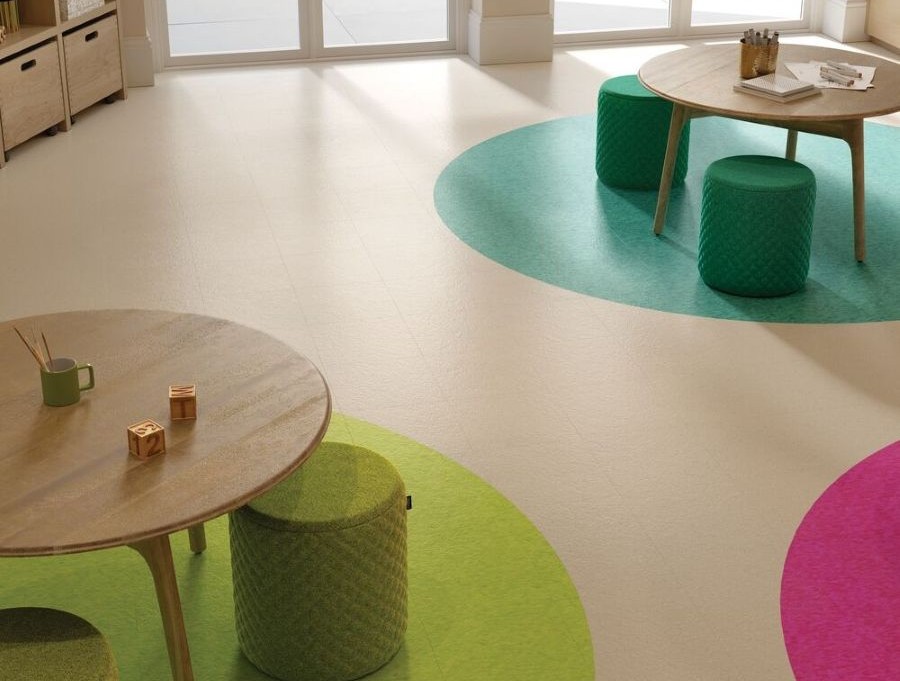
VCT Offers Broader Color Palettes Today
VCT doesn’t aim to imitate natural materials. That remains the strength of LVT, rigid core, and laminate. But that doesn’t make VCT visually limited.
Today’s VCT supports:
- Bold color systems
- Directional layouts
- Custom blends
- Waterjet-cut graphics
- Integrated wayfinding
Collections such as Iliad™ VCT have received industry recognition for design excellence from Interior Design’s Best of Year awards. That recognition reflects how far VCT aesthetics have evolved.
VCT is no longer just a utility surface. It’s become a design tool.
VCT Gives Designers Flexibility
What VCT offers is architectural flexibility. Designers use it to communicate through color, pattern, and spatial organization rather than photographic imagery. The floor becomes part of the building’s language.
In schools and healthcare settings in particular, flooring often serves as a navigational system as much as a finish material.
Designers use VCT to:
- Define circulation paths
- Establish functional zones
- Reinforce branding
- Create rhythm across large spaces
Equally important, VCT integrates easily with other flooring systems. Explore how to mix and match flooring.
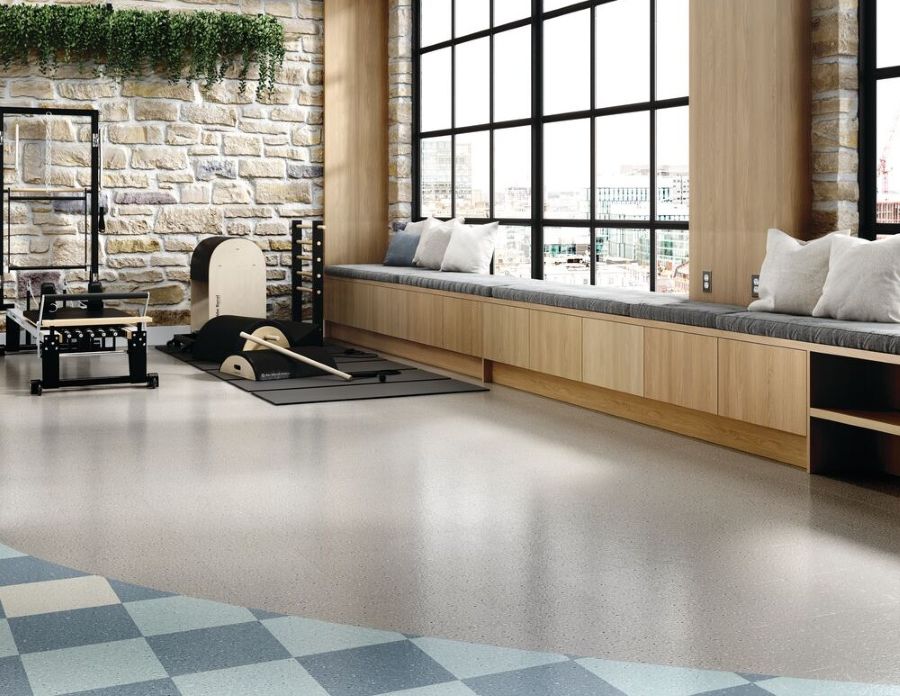
VCT as Part of an Integrated Flooring Strategy
Modern commercial interiors rarely rely on a single product. Instead, flooring systems are layered to reflect patterns of use, foot traffic, and visual emphasis.
“VCT allows designers to think in systems rather than surfaces. It’s not about replicating materials. It’s about using color, pattern, and movement to guide people through space.” – Oxana Dallas, Principal Commercial Designer, AHF™.
VCT fits naturally within these mixed material environments and is commonly used alongside:
- Luxury vinyl tile (LVT)
- Carpet tile
- Porcelain and ceramic tile
- Concrete and terrazzo
Transitions are managed through detailing, subfloor preparation, and appropriate profile systems. When required, leveling compounds can address height differences between surfaces to create smooth, accessible transitions.
When specified correctly, VCT becomes part of a coordinated system rather than a standalone choice. It anchors high-traffic areas where durability is essential and connects naturally to other materials that require different performance or aesthetic qualities.
Read how to use transitional flooring to solve design dilemmas.
Truth 4: Sustainability Includes How Long a Floor Stays in Service
Sustainability doesn’t begin and end with recycled content. It continues through a product’s lifespan and ends with the frequency with which that product is replaced.
Consider how long service life reduces material turnover over the course of decades.
VCT offers environmental value through its longevity, but also through its:
- Long service cycles
- Repairability
- Individual tile replacement
- Reduced material turnover
- Responsible sourcing of limestone
Conserving resources doesn’t always mean installing something new. Sometimes it means choosing what doesn’t need to be replaced every 10 or 15 years.
“A floor that lasts thirty years is more sustainable than one that has to be replaced twice in the same time period. Lifecycle performance is environmental performance.” – Yon Hinkle, Vice President of Resilient Products at AHF™.
The Final Truth About VCT for Commercial Flooring
VCT isn’t a design trend. It remains one of the most trusted performance floors in commercial environments. And it’s remained a commercial constant since its introduction in 1933.
For decades, it has remained in commercial environments where surface materials are tested daily by foot traffic, equipment, cleaning programs, and budget constraints.
VCT endures. That distinction matters in schools that operate year-round, in hospitals that never close, and in retail environments that can’t afford downtime.
AHF Contract® Continues to Advance VCT Solutions
AHF Contract continues to advance VCT through modern design, responsible manufacturing, and performance built for real-world use.
In addition to its elevated colors, Highlights and Iliad include an exclusive Fast Start® factory finish that makes initial maintenance quick and easy, eliminating the need for post-installation scrubbing. The flooring is ready to polish for initial use.
To explore VCT systems for commercial projects, speak with an AHF Contract representative at 1-866-243-2726.
Durable. Repairable. Architecturally flexible. Built for longevity. That’s the truth behind VCT flooring.